This is a popup dialog that overlays the main content of the page. The popup includes a search form to help you find the information you are seeking. Pressing the close button or using the escape key will close the popup.
This guest blog was authored by Arianna Mistry, a graduate student at Arizona State University working with social scientist and geographer Dr. Kelli Larson as part of a larger National Science Foundation Dynamics of Integrated Socio-Environmental Systems project led by Lincoln Park Zoo scientist Dr. Maureen Murray.
The first time I visited Chicago, I was a little girl entranced by the American Girl Doll Store and the Lego Store display at Water Tower Place. In future years, the highlights of trips from my hometown in Michigan would become Lollapalooza and watching the river turn green on St. Patrick’s Day. I was always excited about the glitz and glam of the “big city.” With its skyscrapers and theaters and the Bean, everything seemed so shiny and fast-paced.
During my undergraduate degree in environmental science, cities like Chicago always felt very distant from the forests and meadows I associated with “wildlife” and “nature.” Fieldwork looked like a biological station or a rainforest, not residential neighborhoods. I’ve since learned that cities and nature aren’t nearly as separate as I once thought. It gives me comfort and a sense of optimism to look around at a world that can often feel bleak and industrial and remember that there can be treasure troves of biodiversity right in the middle of the cosmopolitan bustle.
My graduate research is motivated by a desire to understand public perspectives on urban wildlife. Why do some people feel connected to wildlife while others feel threatened or indifferent? To answer this, I am working with Lincoln Park Zoo’s Urban Wildlife Information Network. UWIN collects images of wildlife from motion-sensitive cameras called camera traps and uses them to inform predictive models that estimate where wildlife are likely to be found.
This summer, a UWIN scholarship, which supports collaborators visiting partner institutions, let me spend three weeks at Lincoln Park Zoo. One of my main goals during the visit was to interact more closely with ecologists and spatial analysis experts on the team, building on interdisciplinary relationships that have been mostly remote so far, and gaining hands-on experience with ecological data collection.
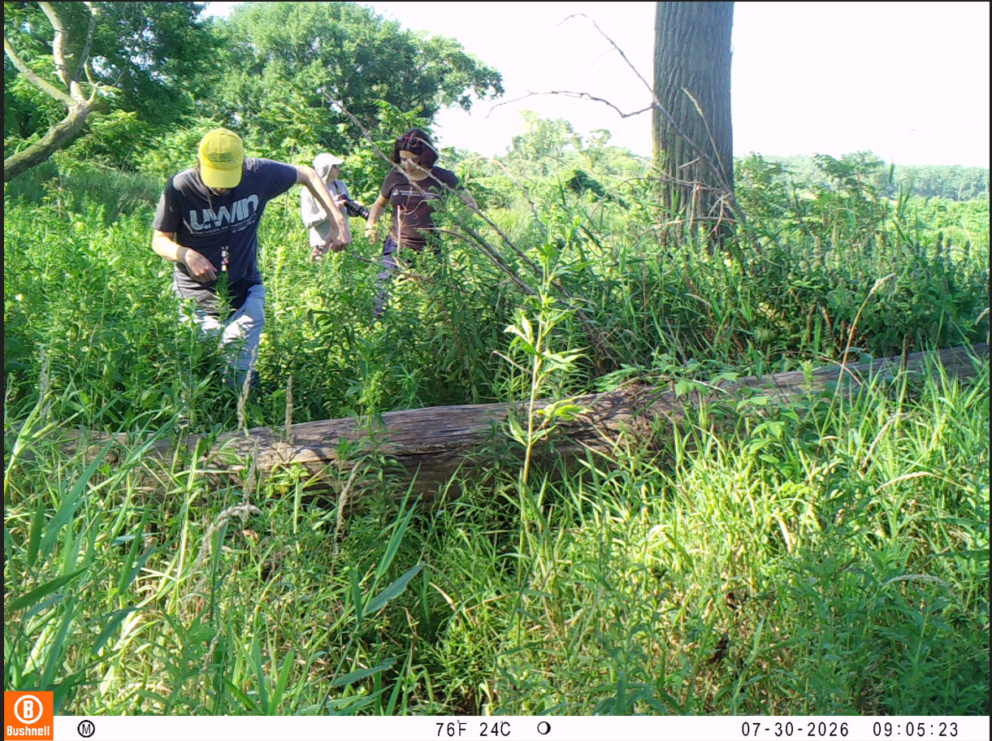
Fieldwork involved collecting camera traps and autonomous recording units from the Chicago UWIN site. Image courtesy of Lincoln Park Zoo’s Dr. Mason Fidino. Featured image courtesy of Maureen Murray, also of Lincoln Park Zoo.
Why Human-Wildlife Interactions?
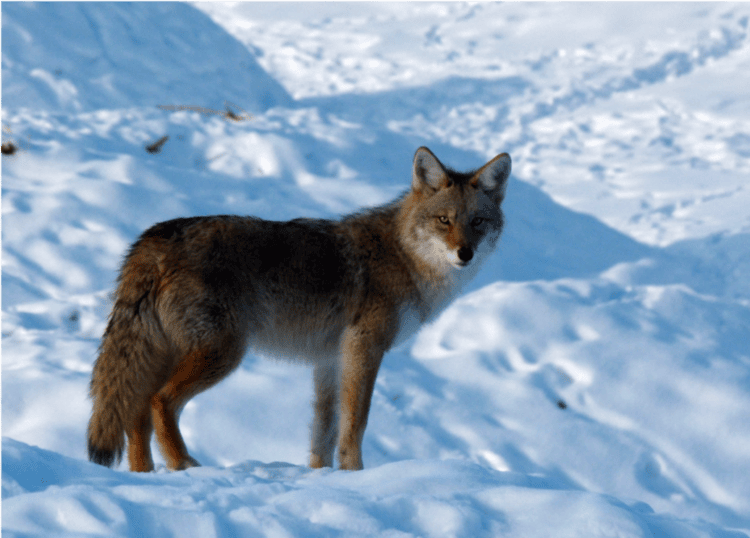
When thinking of “wildlife,” many people imagine big exotic animals. But urban wildlife lives all around us, including butterflies, wasps, spiders, birds, and the animals my project focuses on: coyotes and raccoons. These critters occupy an interesting spot in the public eye. They are seen by some as cute and clever “tricksters,” while others fear coyote attacks or worry about raccoons getting into yards and garbage bins.
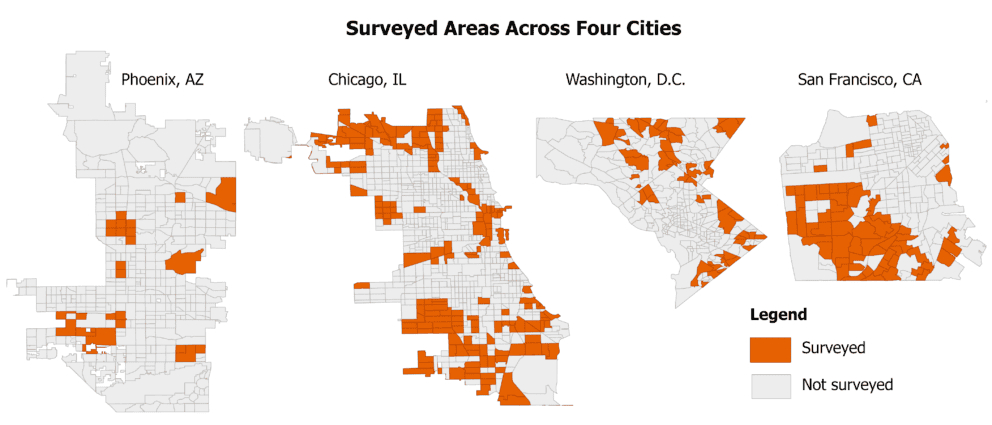
Because landscapes are shaped and managed by human decisions, a goal of our work is to understand people’s willingness to share space with animals. To do this, our team sent surveys to residents across four cities: Chicago, San Francisco, Phoenix, and Washington, D.C. We asked about people’s experiences with, attitudes towards, and behaviors around coyotes and raccoons. Do they perceive these animals as dangerous? Nuisances? Beneficial to the environment? Who would they call if they saw one? These responses can show us trends in people’s perceptions of and attitudes towards wildlife in cities, and how those perceptions influence wildlife management outcomes.
The UWIN Urban Carnivores survey sampling approach. To ensure we surveyed people who had seen or experienced wildlife around them, we mailed surveys to residents in areas where both humans and wildlife were likely to be. “Not surveyed” areas were excluded due to low human population based on census data or low wildlife occupancy based on UWIN predictive models.
Chicago As a Field Site
In July, I traded my desk for a pair of rain boots and went out to collect camera traps with two ecologists, who peppered the conversation with facts about the birds and plants we passed. Earwigs, ants, and funnel weaver spiders tumbled out of the camera cases as we untied them from the trees. It was a little more creepy-crawly than the coyotes I study, but it brought to life the data I had been looking at for months on a computer. Instead of clicking on maps of the Chicago landscape, I was actually in it!
Photos from field visits to Chicago urban gardens.
UWIN works with all kinds of wildlife across the city, so in addition to the camera trap collection, I got to experience other facets of urban wildlife fieldwork. In urban community gardens, we used a plant identification app to collect data on urban pollinators and plants. It was research, but it was also kind of meditative. We observed insects in three-minute periods and saw a number of different species, from bumblebees and sunflower bees to cabbage white butterflies and mud dauber wasps. I was reminded that it really doesn’t take long to notice the biodiversity around you, even in a city.
Between garden visits, I also got to poke around the Chicago alleys for the Chicago rat birth control project. Rodenticides can unintentionally poison urban carnivores like coyotes and raccoons, so contraceptive rat control offers a more wildlife-friendly, sustainable alternative.
Rat tracks in ink. This fieldwork is part of a project on contraception methods for rodent control with Lincoln Park Zoo’s Dr. Maureen Murray.
Looking at the little rat tracks in ink and thinking back to the pollinators, I wondered what makes certain species seem beautiful or fascinating and others pests. Both are important to the natural ecosystem. Perhaps it’s simply the environment they’re seen in. But who decides where people’s outdoor spaces end and wildlife’s begin?
The Familiarity Hypothesis
The preliminary analysis from our Urban Carnivores survey tests the “familiarity hypothesis,” or the idea that greater familiarity with a hazard can lower perceived risk. Think, for example, of the tornadoes in Chicago this summer. People who have never experienced a tornado before may feel more threatened than those who have weathered many.
Applying this idea to wildlife, we want to know whether more experience with coyotes and raccoons reduces perceived risks (e.g., attacks, disease, property damage) and raises perceived benefits (e.g., enjoyment, ecosystem benefits, pest management). Results to date from 1,814 survey respondents indicate this is true for coyotes but not raccoons. People who regularly encounter coyotes are less worried about the rare chance of an attack, while negative feelings toward raccoons mostly came from their encounters with trash cans.
Lessons for Future Work
I spent part of my visit discussing these preliminary findings with the full Urban Carnivores Project research team. Further analysis of the survey data will be the focus of my master’s thesis later this year. But the survey is only one part of a much larger effort to understand urban human-wildlife dynamics, with other team members focused on other types of data and topics like support for lethal control, wildlife disease, coexistence attitudes, and interviews with wildlife managers.
The UWIN Urban Carnivores Project Research Team meeting at Lincoln Park Zoo.
Being in a room with researchers who continue to step outside their own disciplinary silos changed how I think about my own analysis. As I listened to other presentations that, instead of human perspectives, focused on spatial patterns or animal behavior, I thought about how the behavior of an animal might factor into the familiarity hypothesis. Perhaps unlike the natural disasters that the theory often describes, familiarity with wildlife is a two-way street where animals behave differently over time, too.
Moving from a meditative garden to a forest next to a graveyard to an alley dotted with rat tracks also had me thinking about how much an encounter depends on the built environment rather than just an animal or person. Signage, greenery, foot traffic—all of this sets an expectation for whether an animal “belongs,” before an animal ever shows up. In the context of the familiarity hypothesis, I wondered what landscape features might shape a person’s experience of wildlife. Time spent in the field also inspired ideas about what made me feel connected to nature, and how connectedness with nature might color other people’s encounters with animals.
My biggest takeaway from these three weeks in Chicago was that research gets richer when you leave your desk for it—and when you let people with different expertise show you a new perspective. I traveled home feeling closer to a city I’m studying and full of new questions. In the rest of my master’s analysis, I will run a series of models to test how people’s values, backgrounds, and experiences with wildlife relate to their perceptions of coyotes and raccoons. Thanks to this trip, I was inspired to later explore how animal behavior, landscape features, and nature connectedness may also influence “familiarity” with wildlife. Experiencing wildlife, it seems, involves so much more than simply seeing an animal.